

Mobilex Kakadu: self-propelled shower commode chair with large 24″ wheels








The Kakadu with large wheels is a self-propelled shower commode chair that lets the user move around independently – the 24″ rear wheels have pushrims, and the front of the chair rests on two 5″ swivel castors with brakes. It works as a shower chair, a commode with a removable bucket and a way of getting to the bathroom. The chair is available in 45, 50 and 55 cm seat widths, with a maximum user weight of up to 200 kg.
Key features of the Kakadu with 24″ wheels
- Independent mobility – the 24″ rear wheels with pushrims let users get to the bathroom or into the shower on their own.
- Secure grip, even with wet hands – the pushrims have an anatomically shaped inner section.
- Solid tyres – the 24″ wheels have solid tyres, with no inner tubes to inflate.
- Quick-release wheels – the 24″ wheels are fitted with quick-release axles, so they can be taken off, for example to transport the chair.
- Parking brakes – the 24″ wheels have lever-operated parking brakes; the front 5″ castors have foot-operated brakes.
- Shower and toilet in one – seat with hygiene cut-out, removable commode bucket with lid, and the option to wheel the chair over a standard toilet.
- Easy transfers – flip-up armrests and swing-away footrests that come off without tools.
- Resistant to moisture – powder-coated aluminium frame, stainless steel screws, and materials that withstand corrosion and disinfection.
Who is the self-propelled shower commode chair for?
The version with 24″ wheels is intended for people with limited ability to stand and walk who cannot use a regular shower cubicle, bath or toilet, but who still have enough arm strength and grip to propel the chair with the pushrims. It suits users who want to stay independent in their daily hygiene and who have room at home or in their care facility for a wider chair.
The chair can be used at home, in long-term care facilities and in hospitals – indoors only, on a level floor.
Contraindication: the chair should not be used by people who cannot maintain a stable sitting position. Users with cognitive impairment must be supervised. The choice of chair should be made together with a doctor or physiotherapist.
What the 24″ wheels change
The large-wheel version is a Kakadu chair in which the rear 5″ castors are replaced with the 24″ wheel kit (item no. 302017). The kit contains wheels with pushrims and solid tyres, quick-release mechanisms, parking brakes with brackets and all fitting parts. The wheels can be mounted at one of three heights; after fitting, the front castors are adjusted so that the seat is parallel to the floor.
The large wheels change the chair’s dimensions: overall width increases by 9.5 cm, length by 19 cm and weight by 4.2 kg. With a 45 cm seat the chair is therefore 65.5 cm wide – worth checking against the width of your bathroom door. Seat height (50–55 cm) and toilet clearance stay the same as on the small-wheel version.
The 24″ wheel brakes are only for holding the chair in place when parked – they must not be used to slow the chair while moving. For Kakadu chairs with 24″ wheels, the manufacturer recommends using an anti-tip.
Design and adjustment
Frame and upholstery
The frame is made of white powder-coated aluminium tubing, with steel parts and screws in stainless steel. The seat, backrest and armrest pads are made of soft black PU foam that is easy to wash and disinfect.
Seat and commode bucket
The seat with hygiene cut-out is held by clips and comes off without tools; the opening is closed with a removable cover. The bucket with lid slides out of the guide rails under the seat from the rear – even while the user is seated. To use the toilet, simply remove the bucket and cover and wheel the chair backwards over the toilet bowl.
Armrests and footrests
The armrests flip up to make side transfers easier. The footrests are length-adjustable, have folding footplates and a release lever – once swung aside, they can be lifted off. Set the footrest length so that the thighs rest flat on the seat and the feet rest on the footplates.
Standard equipment
- main frame with PU seat with hygiene cut-out and removable opening cover,
- detachable backrest frame with PU backrest and flip-up armrests,
- 2 detachable swing-away footrests,
- 2 front 5″ swivel castors with brakes,
- 2 rear 24″ wheels with pushrims, solid tyres and quick-release axles,
- 2 parking brakes for the 24″ wheels,
- commode bucket with lid,
- tools and instructions for use.
Accessories for the Kakadu with large wheels
The accessories listed below are optional extras – they are not included with the chair and are charged separately. Order them separately, choosing the version that matches the chair’s seat width. The table shows which seat width each accessory fits.
| Accessory | Item no. | Kakadu 45 cm (302018) | Kakadu 50 cm (302019) | Kakadu 55 cm (302020) |
|---|---|---|---|---|
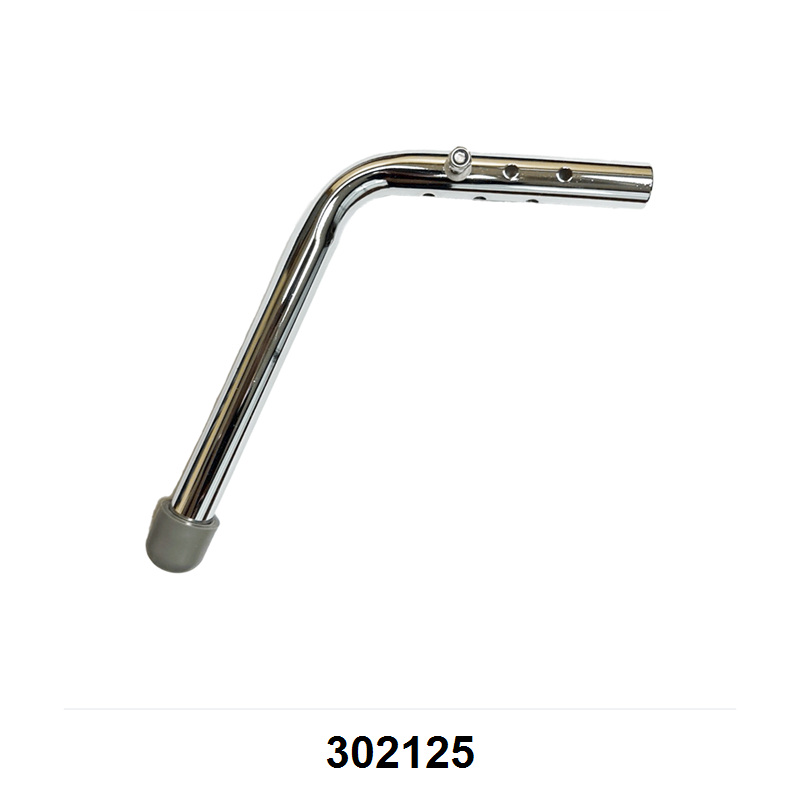
| Anti-tip, 1 pc | 302125 | yes | yes | yes |
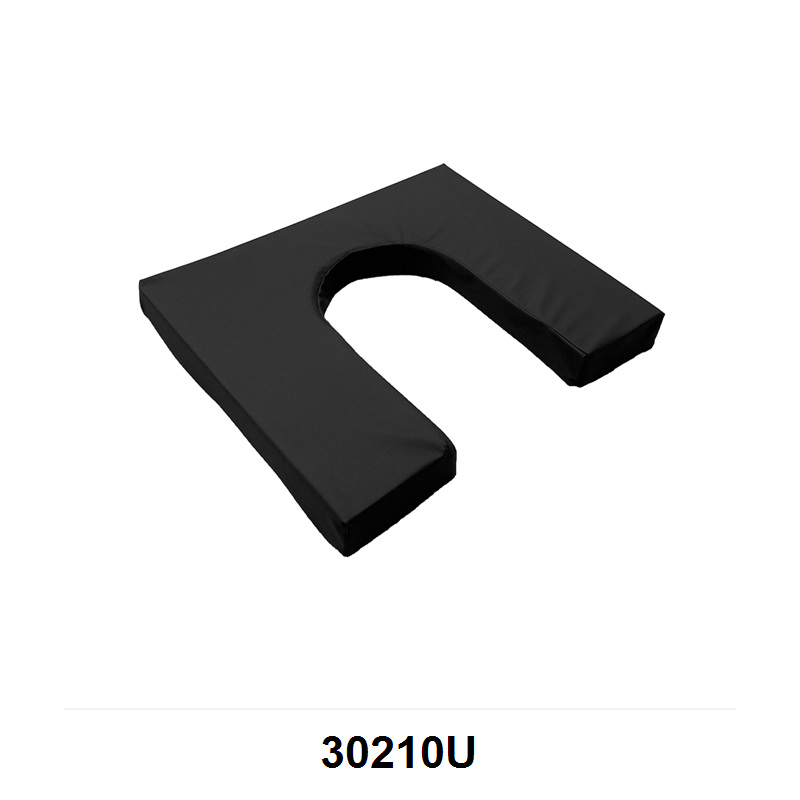
| Seat cushion, open front, with hygiene cut-out | 30210U | for the standard seat with hygiene cut-out (open front); cushion size 45 × 40 cm – ask about fit for your seat width | ||
| Seat cushion, closed front, for seat with round hole | 30211U | only for the optional seat with round hole (closed front); cushion size 45 × 40 cm – ask about fit | ||
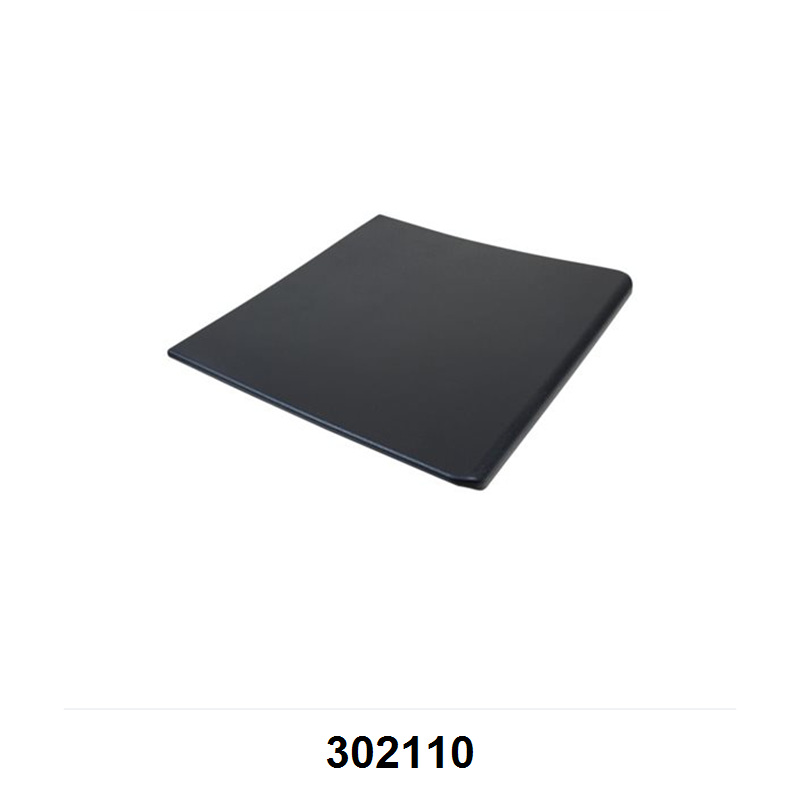
| Seat plate lid (covers the whole seat) | different for each size | yes (302110) | yes (302155) | yes (302157) |
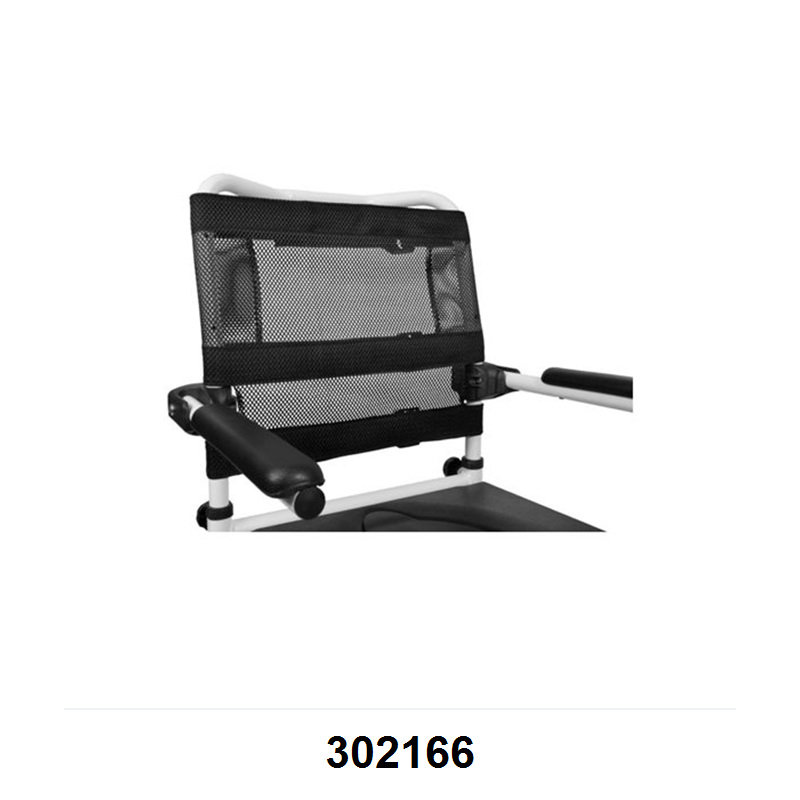
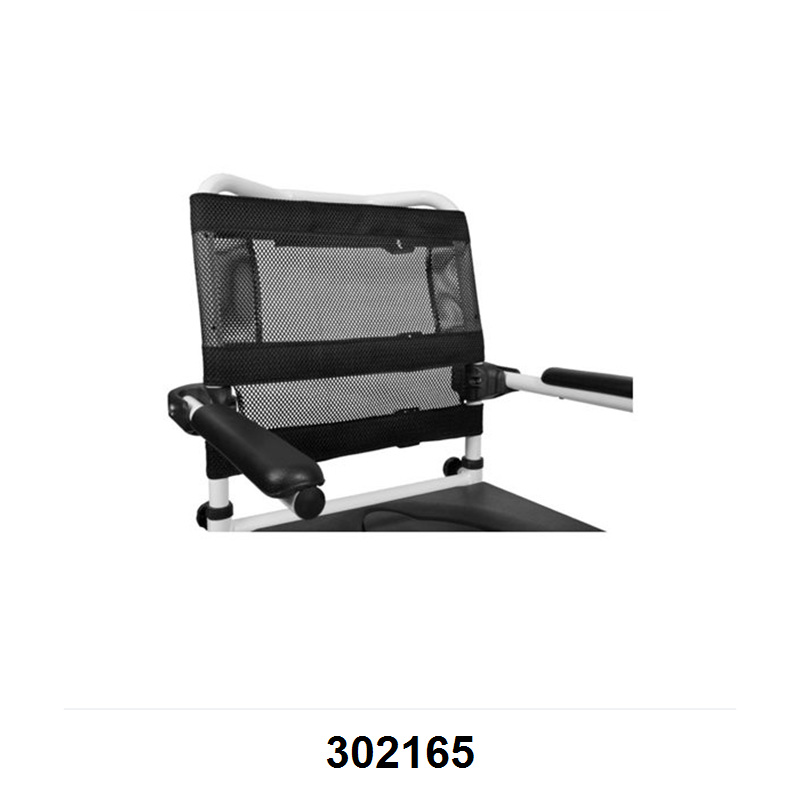
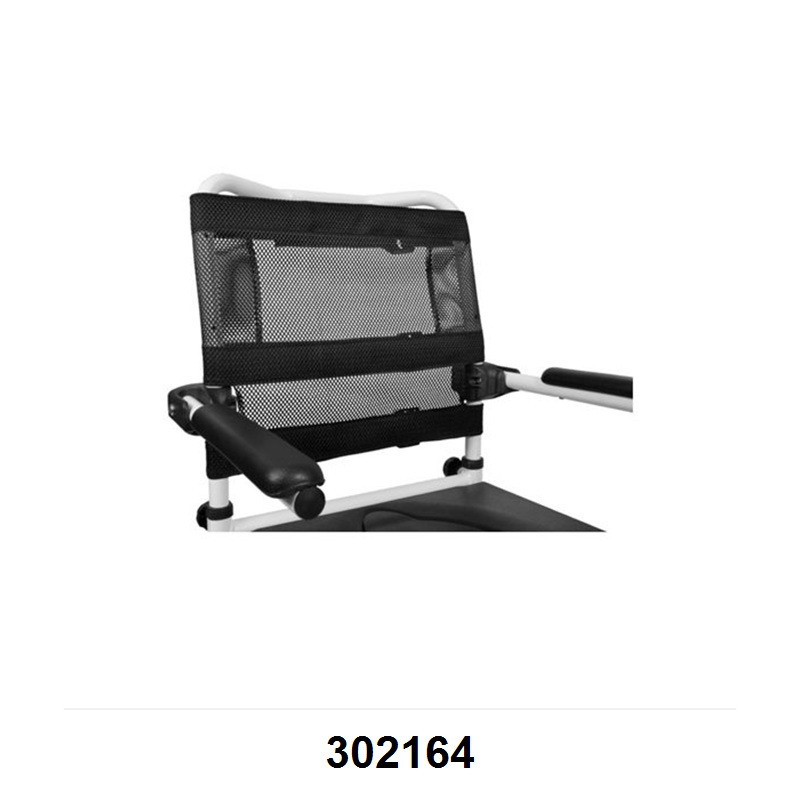
| Adjustable strap backrest | different for each size | yes (302164) | yes (302165) | yes (302166) |
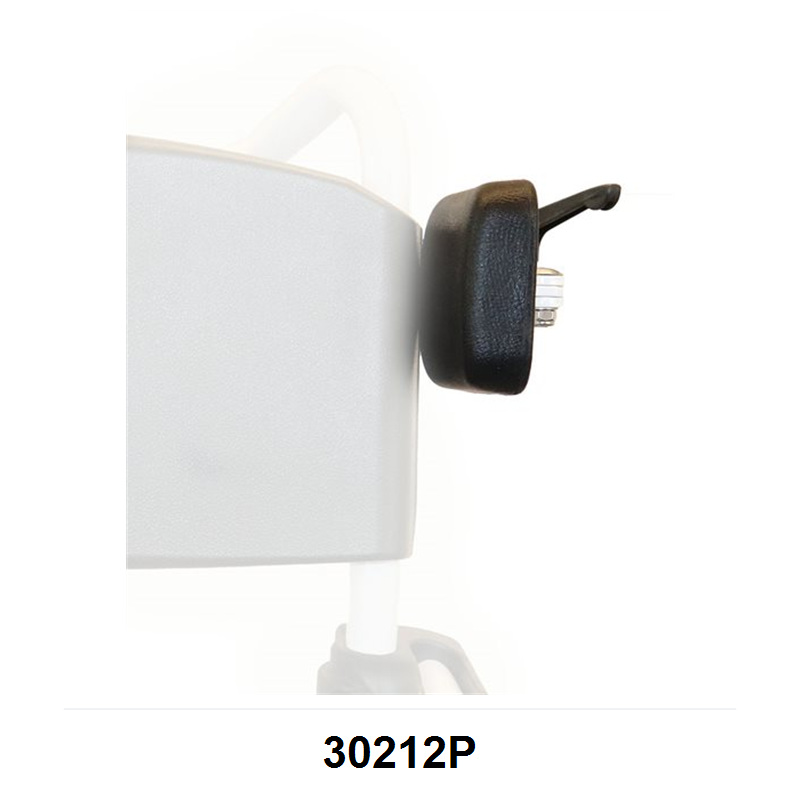
| Side support pads 10 × 14 cm (left / right) | 30212P / 30212R | yes** | yes** | yes** |
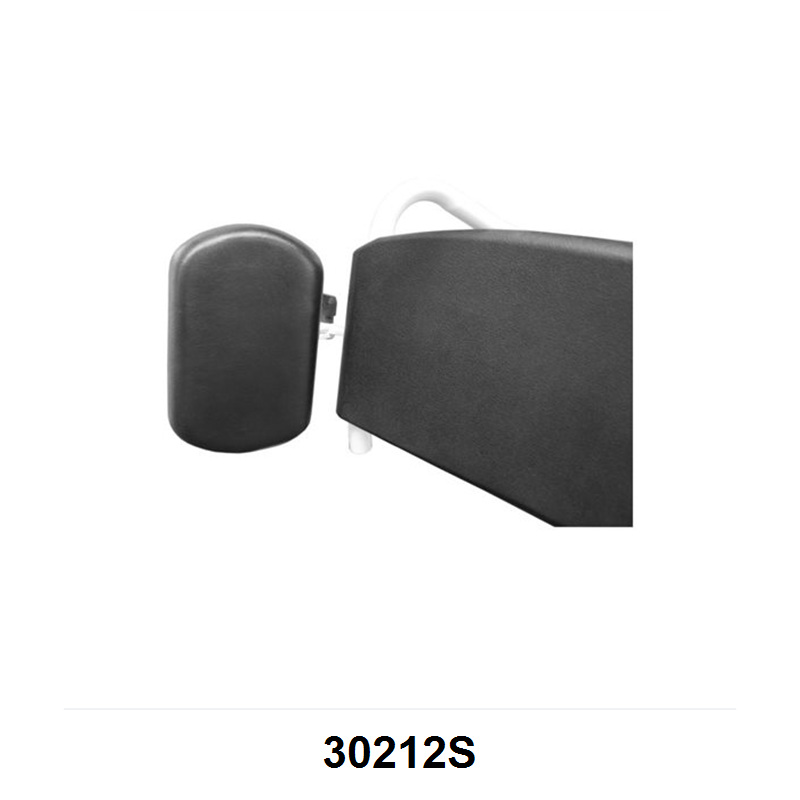
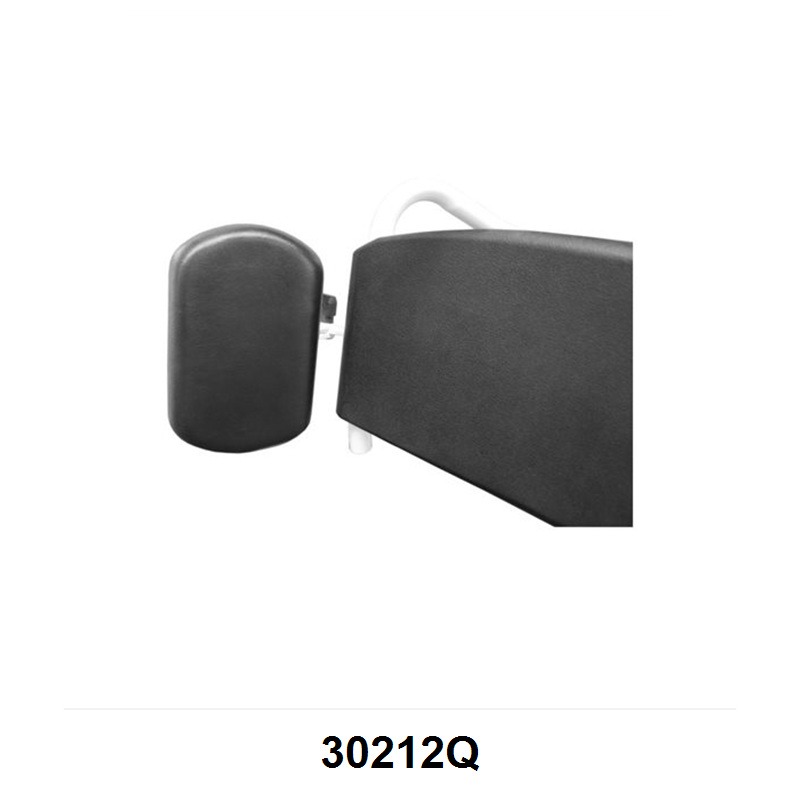
| Side support pads 14 × 20 cm (left / right) | 30212Q / 30212S | yes** | yes** | yes** |
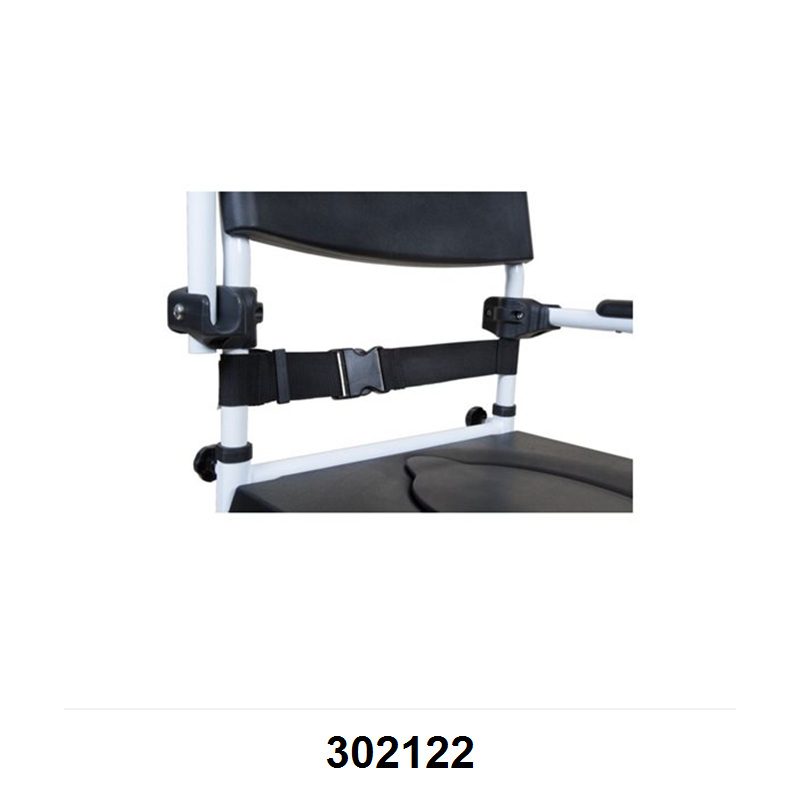
| Safety belt / backrest strap | 302122 | yes | yes | yes |
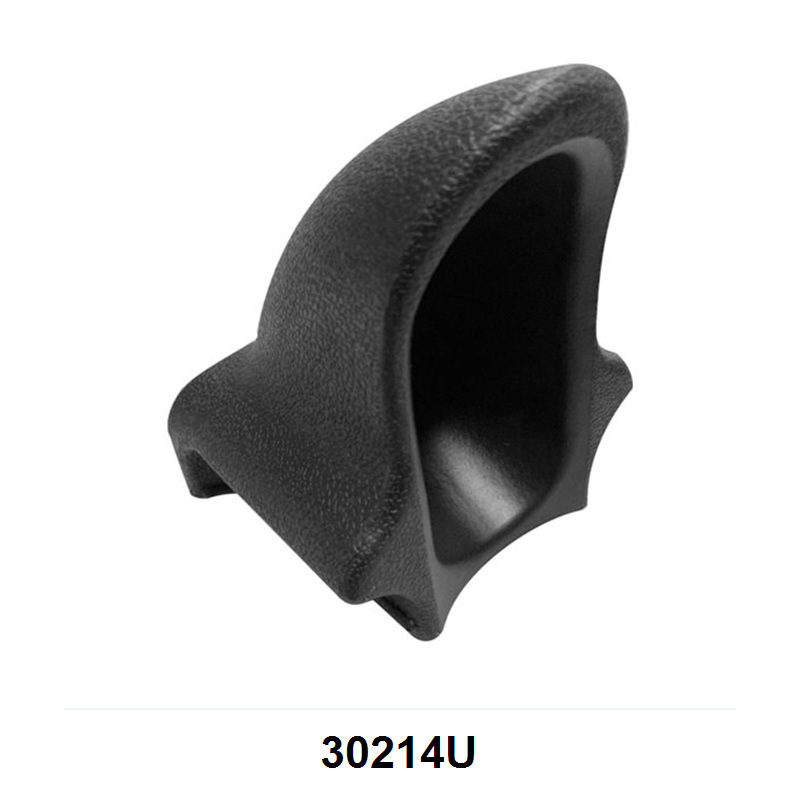
| Splash guard | 30214U | yes | no | no |
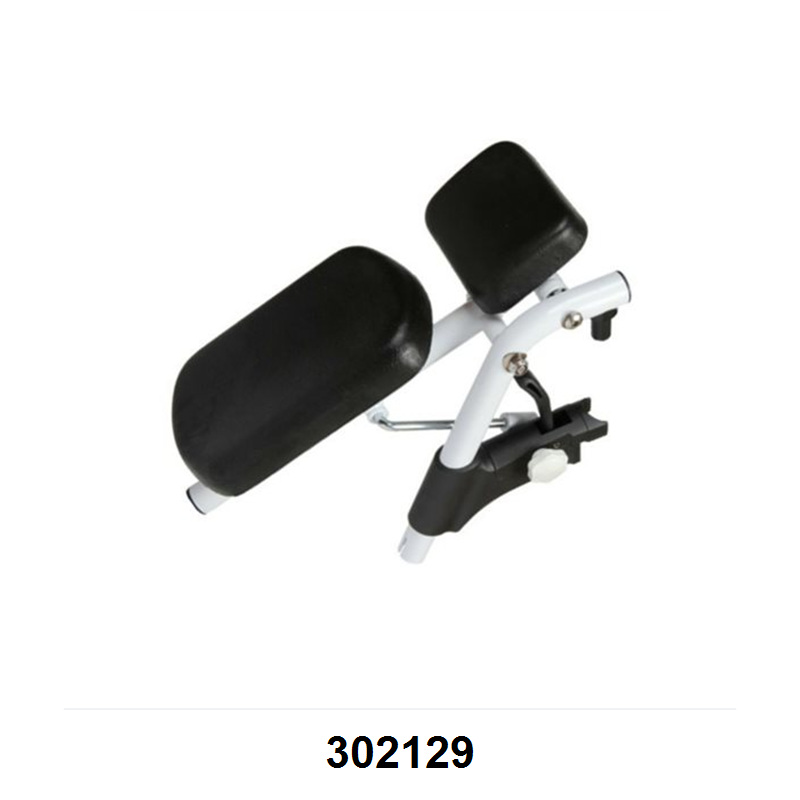
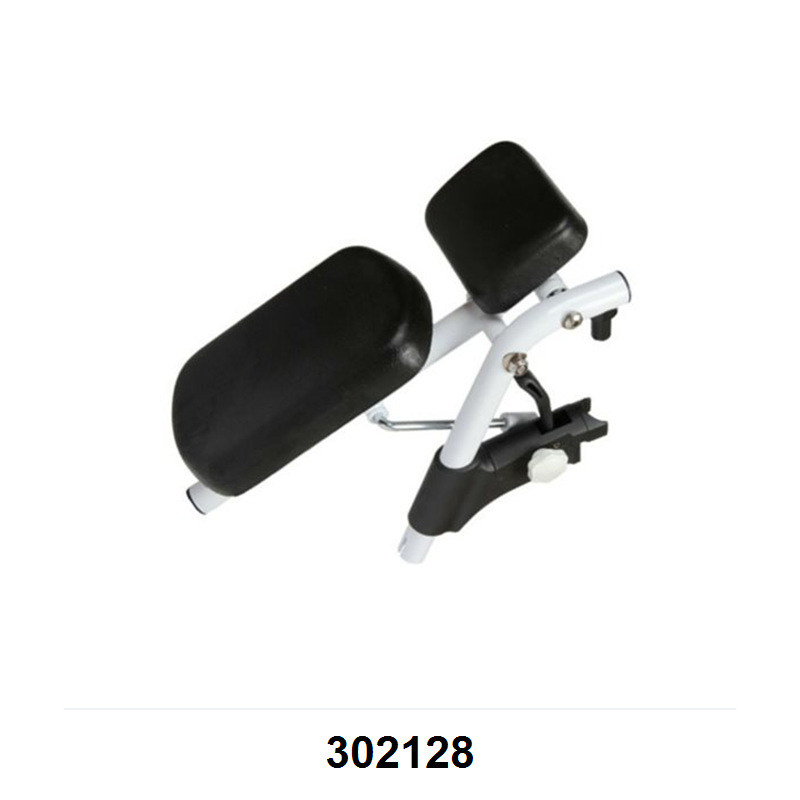
| Amputation support (left / right) | 302128 / 302129 | yes | yes | yes |
| Closed footplate 165 × 320 mm | 30212Z | yes | yes | yes |
| ** side support pads can only be fitted with the standard backrest – they cannot be combined with the adjustable strap backrest | ||||
Anti-tip 302125
Designed for all Kakadu chairs with 24″ rear wheels. The manufacturer recommends using it whenever the chair is fitted with large wheels. Sold individually (1 pc).
Seat cushions 30210U and 30211U
Soft cushions with a Decutex cover, 45 × 40 × 5 cm, with fully welded seams (water-resistant, zip-free cover), 50 kg/m³ foam and an anti-slip underside. They add comfort compared with the standard PU seat. 30210U (open front) fits the standard seat with hygiene cut-out; 30211U (closed front) fits the seat with a round hole.
Seat plate lid 302110 / 302155 / 302157
A soft PU plate that covers the whole seat and sits in the cut-out, so it does not shift when the user moves. Useful when the chair serves as a shower chair or for getting around the home. The item number depends on seat width: 302110 – 45 cm, 302155 – 50 cm, 302157 – 55 cm. When the opening is covered, the bucket with lid must be in place under the seat.
Adjustable strap backrest 302164 / 302165 / 302166
A backrest with three adjustable hook-and-loop straps for setting the tension to the shape of the user’s back. The perforated surface does not absorb water and lets air through. Choose by seat width: 45 cm – 302164, 50 cm – 302165, 55 cm – 302166.
Side support pads
Moulded polyurethane pads mounted on the backrest tube or at the seat, with stepless position adjustment. Small 10 × 14 cm (30212P left, 30212R right) and large 14 × 20 cm (30212Q left, 30212S right). Standard backrest only.
Safety belt 302122
A belt with no metal parts, attached with loops around the backrest tubes. Loosened, it works as a safety belt; tightened, as a back strap supporting the lumbar area.
Splash guard 30214U
A soft polyurethane guard fitted without tools to the front edge of the hygiene cut-out on the standard 45 cm seat. It limits splashing outside the bucket and acts as a spacer between the legs.
Amputation supports 302128 / 302129
Fitted without tools in place of the standard footrest. Two moulded polyurethane shells with independent angle adjustment hold the residual limb in the right position.
Closed footplate 30212Z
One 165 × 320 mm plate in place of two separate footplates – a shared support surface for both feet.
Large wheels, small wheels or Kakadu Tilt?
- Kakadu with large 24″ wheels – when the user can and wants to propel the chair independently, and the bathroom and doorways have room for a wider chair.
- Kakadu with small wheels – when the chair is pushed by a carer; it is narrower and shorter, and also available as the XXL (61 cm, up to 270 kg), which cannot be fitted with 24″ wheels.
- Kakadu Tilt – when seat tilt adjustment and a headrest are needed; the Kakadu Tilt can also be fitted with 24″ wheels.
See the full range in toilet and bathroom products.
Safe use
- When parked, and when the user sits down or stands up, both 24″ wheel brakes must be applied – push the lever forward to apply.
- The 24″ wheel brakes are not for slowing down while moving.
- Use the chair indoors only, on a level floor without thresholds or obstacles.
- Do not stand on the footrests and do not slide to the front edge of the seat with your feet on the footrests.
- Do not exceed the maximum user weight: 150 kg (45 and 50 cm) or 200 kg (55 cm).
- Each time the wheels are fitted, check that they are securely locked by trying to pull them out.
Frequently asked questions
Can the user propel the 24″ wheel chair on their own?
Yes, if the user has sufficient arm strength and grip. The pushrims have a shaped inner section that makes them easier to grip, even with wet hands.
How much space does the Kakadu with large wheels need?
Overall width is 65.5 cm (45 cm seat), 70.5 cm (50 cm) or 75.5 cm (55 cm), and the length is 112 cm. Measure the bathroom door and the turning space before buying.
Is an anti-tip needed?
The manufacturer recommends an anti-tip (item no. 302125) on all Kakadu chairs with 24″ wheels. It is not part of the standard equipment – it is an optional, separately charged accessory.
Can the large wheels be removed?
Yes. Remove the cap, press the quick-release button and the wheel slides out of its housing. When refitting, check that the wheel is properly locked.
Will the large-wheel chair fit over a toilet?
Yes. The clearance under the frame is the same as on the small-wheel version: 42–47 cm (45 and 50 cm) and 40–45 cm (55 cm). With the bucket and cover removed, the chair is wheeled backwards over the toilet bowl.
Is there an XXL version with large wheels?
No. The manufacturer does not approve fitting 24″ wheels to the Kakadu XXL (61 cm seat, up to 270 kg); it is available with small wheels only.
How should the wheels be maintained?
Wash the wheels with hot water and a mild detergent, and oil the bearings periodically – especially after washing or if they start to squeak. In very hard water, limescale may build up on the bearings; remove it with a descaler.
| Specification | Kakadu 45 cm with 24″ wheels | Kakadu 50 cm with 24″ wheels | Kakadu 55 cm with 24″ wheels |
|---|---|---|---|
| Chair item no. | 302018 | 302019 | 302020 |
| 24″ wheel kit item no. | 302017 | ||
| Seat width | 45 cm | 50 cm | 55 cm |
| Seat depth | 43 cm | ||
| Seat height (adjustable) | 50–55 cm | ||
| Distance between armrests | 46.5 cm | 51.5 cm | 56.6 cm |
| Backrest height | 46 cm | ||
| Seat / backrest angle | 90° / 12° | ||
| Pass-over height (toilet clearance) | 42–47 cm | 42–47 cm | 40–45 cm |
| Pass-over width | 40 cm | 45 cm | 50 cm |
| Overall width | 65.5 cm | 70.5 cm | 75.5 cm |
| Overall length | 112 cm | ||
| Overall height (adjustable) | 96–101 cm | ||
| Maximum user weight | 150 kg | 150 kg | 200 kg |
| Chair weight with 24″ wheels | 17.1 kg | 17.7 kg | 18.3 kg |
| Front wheels | 2 swivel castors 5″ (125 mm) with foot brakes | ||
| Rear wheels | 2 × 24″ wheels with pushrims, solid tyres and quick-release axles; lever-operated parking brakes | ||
| Change compared with the small-wheel version | width +9.5 cm, length +19 cm, weight +4.2 kg | ||
| Frame | aluminium, white | ||
| Seat, backrest, armrests | soft PU foam, black | ||
| Standard equipment | commode bucket with lid, removable seat opening cover, flip-up armrests, detachable length-adjustable footrests | ||
| Place of use | indoors only | ||
| Recommended service life | normally 10 years, depending on use | ||
